Explore Hi-Fi the better way.
Research components, plan your system, keep your whole hi-fi life in one place, and make every decision backed by product data and physics.
Explore Hi-Fi the better way.
Research components, plan your system, keep your whole hi-fi life in one place, and make every decision backed by product data and physics.
Explore Hi-Fi the better way.
Research components, plan your system, keep your whole hi-fi life in one place, and make every decision backed by product data and physics.
Hi-Fi Search.
Exploring hi-fi starts with the search.
Behind it sits the core of the whole platform: the Pure Neo hi-fi database, where brands, their components, and every component's specifications are collected in one place.

Search by name when you know what you're looking for. Search by what a component does when you don't.
The advanced search lets you pick a category, set the specs that matter to you, and every component in the database that fits comes back. Speakers with a sensitivity above 90 dB, cartridges with a compliance between 15 and 20 µm/mN, whatever helps you find it is there.
Is this the biggest hi-fi database on earth? Most likelely yes.
We're not done yet. Our long-term goal is to cover 98% of every hi-fi component ever built! Until then some searches will come up empty. When a product isn't there yet, you request it and we take it from there. The requested product goes straight into your lists as a placeholder and we work in the background to get the specs for you.

When a manufacturer brings their own content to the platform, the product page gets their official images, descriptions, and downloads, presented the way they intended. And they look gorgeous.
We just started and only a few brands have done this yet. The more that do, the better your research gets. If a brand you care about isn't here, ask them to join.
The specifications are on us. We collect and maintain them across the entire database, whether or not a manufacturer is actively involved. Reviews and dealer locations are different: they come from the people who add them.
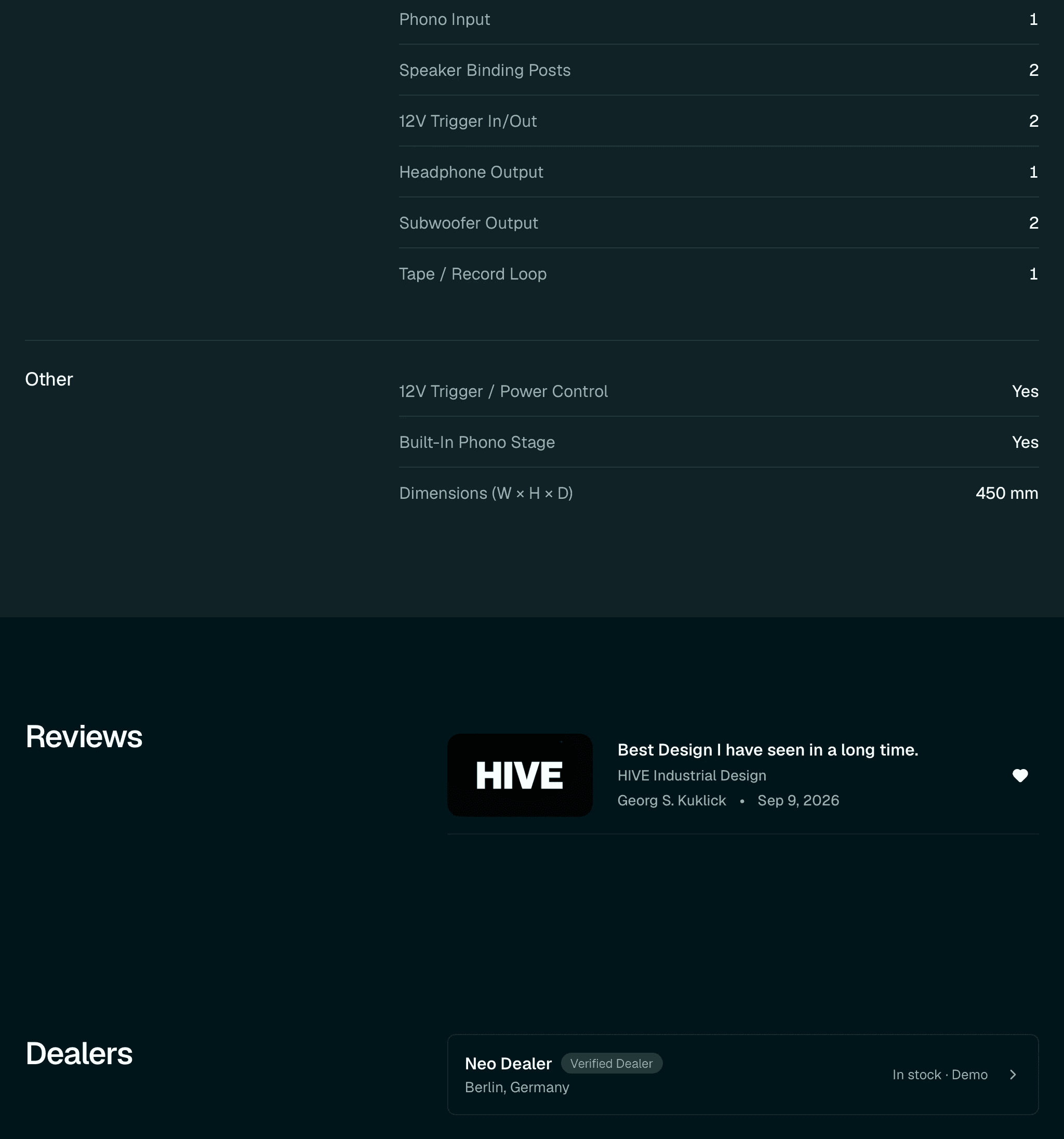
When a reviewer covers a component, their work appears on the product page. When a dealer carries the product, their store shows up with stock and location.
We built the foundation. Every brand, reviewer, and dealer who joins makes it more useful for everyone.
Setups
Setups is where you build your hi-fi systems: the one you actually own, the one you're planning next, or the one you dream about.
Rebuild what you have at home, add photos of it, and share it on your public profile or social media.
A shared setup link previews as the setup itself, with your components and photos, so fellow enthusiasts see your system before they click. Whatever you switched off in the setup settings stays off.

Setups also help you plan ahead. Plan your next upgrade around real components. Or put together the cost-no-object dream system, just for the joy of it.
Like the setups that catch your eye, and they stay on your My Hi-Fi page.
Looking up prices can be annoying. AI price search does it for you: it fetches prices per component and totals the whole setup in one click, whether that's the system at home, the one you're planning, or the dream you've been curating. Whether anyone else sees that number is your call in the setup settings.
See the founder's Setup here.
Setups
Setups is where you build your hi-fi systems: the one you actually own, the one you're planning next, or the one you dream about.
Rebuild what you have at home, add photos of it, and share it on your public profile or social media.
A shared setup link previews as the setup itself, with your components and photos, so fellow enthusiasts see your system before they click. Whatever you switched off in the setup settings stays off.
Setups also help you plan ahead. Plan your next upgrade around real components. Or put together the cost-no-object dream system, just for the joy of it.
Like the setups that catch your eye, and they stay on your My Hi-Fi page.
Looking up prices can be annoying. AI price search does it for you: it fetches prices per component and totals the whole setup in one click, whether that's the system at home, the one you're planning, or the dream you've been curating. Whether anyone else sees that number is your call in the setup settings.
See the founder's Setup here.
Setups
Setups is where you build your hi-fi systems: the one you actually own, the one you're planning next, or the one you dream about.
Rebuild what you have at home, add photos of it, and share it on your public profile or social media.
A shared setup link previews as the setup itself, with your components and photos, so fellow enthusiasts see your system before they click. Whatever you switched off in the setup settings stays off.
Setups also help you plan ahead. Plan your next upgrade around real components. Or put together the cost-no-object dream system, just for the joy of it.
Like the setups that catch your eye, and they stay on your My Hi-Fi page.
Looking up prices can be annoying. AI price search does it for you: it fetches prices per component and totals the whole setup in one click, whether that's the system at home, the one you're planning, or the dream you've been curating. Whether anyone else sees that number is your call in the setup settings.
See the founder's Setup here.
My Hi-Fi
My Hi-Fi is where your whole hi-fi life comes together in one place: the system you run today, the components you want next, and everything you've owned along the way.

You collect as you go. Like a component while browsing and it's saved. Put spare gear on the Shelf, upgrades on the Wishlist, and reviews worth reading again stay within reach. Nothing you found gets lost, and when decision time comes, it's all there.
Following is your personal hi-fi network: the brands you care about, the dealers you buy from, the reviewers you trust, and fellow enthusiasts you've discovered. Each has its own list, so any of them is one look away.

The Hi-Fi Journey is where you tell your hi-fi story. Add the components you've owned over the years, each with the year you got it, and the timeline draws the path from your first system to the one you run today. For many, this journey has only ever existed in their heads and in conversations between people who share the passion. This gives it a place.
The Hi-Fi Journey is an early prototype: it depends on a catalogue that reaches decades back, and coverage of older and vintage components is still ahead. We plan to open vintage cataloguing to the community.
Your My Hi-Fi page has a public side: a page to share with anyone, on Pure Neo, the web, or social media.
See the founder's My Hi-Fi page here.
My Hi-Fi
My Hi-Fi is where your whole hi-fi life comes together in one place: the system you run today, the components you want next, and everything you've owned along the way.
You collect as you go. Like a component while browsing and it's saved. Put spare gear on the Shelf, upgrades on the Wishlist, and reviews worth reading again stay within reach. Nothing you found gets lost, and when decision time comes, it's all there.
Following is your personal hi-fi network: the brands you care about, the dealers you buy from, the reviewers you trust, and fellow enthusiasts you've discovered. Each has its own list, so any of them is one look away.
The Hi-Fi Journey is where you tell your hi-fi story. Add the components you've owned over the years, each with the year you got it, and the timeline draws the path from your first system to the one you run today. For many, this journey has only ever existed in their heads and in conversations between people who share the passion. This gives it a place.
The Hi-Fi Journey is an early prototype: it depends on a catalogue that reaches decades back, and coverage of older and vintage components is still ahead. We plan to open vintage cataloguing to the community.
Your My Hi-Fi page has a public side: a page to share with anyone, on Pure Neo, the web, or social media.
See the founder's My Hi-Fi page here.
My Hi-Fi
My Hi-Fi is where your whole hi-fi life comes together in one place: the system you run today, the components you want next, and everything you've owned along the way.
You collect as you go. Like a component while browsing and it's saved. Put spare gear on the Shelf, upgrades on the Wishlist, and reviews worth reading again stay within reach. Nothing you found gets lost, and when decision time comes, it's all there.
Following is your personal hi-fi network: the brands you care about, the dealers you buy from, the reviewers you trust, and fellow enthusiasts you've discovered. Each has its own list, so any of them is one look away.
The Hi-Fi Journey is where you tell your hi-fi story. Add the components you've owned over the years, each with the year you got it, and the timeline draws the path from your first system to the one you run today. For many, this journey has only ever existed in their heads and in conversations between people who share the passion. This gives it a place.
The Hi-Fi Journey is an early prototype: it depends on a catalogue that reaches decades back, and coverage of older and vintage components is still ahead. We plan to open vintage cataloguing to the community.
Your My Hi-Fi page has a public side: a page to share with anyone, on Pure Neo, the web, or social media.
See the founder's My Hi-Fi page here.
Compare components
When your exploration comes down to a few candidates, pick up to three and see their specs side by side in one view, with the differences standing out at a glance. No more juggling tabs and spec sheets.
Compatibility match is rolling out in beta this fall.
Compare components
When your exploration comes down to a few candidates, pick up to three and see their specs side by side in one view, with the differences standing out at a glance. No more juggling tabs and spec sheets.
Compatibility match is rolling out in beta this fall.
Compare components
When your exploration comes down to a few candidates, pick up to three and see their specs side by side in one view, with the differences standing out at a glance. No more juggling tabs and spec sheets.
Compatibility match is rolling out in beta this fall.
Compatibility match
Matching components is its own discipline in hi-fi. A cartridge has to suit its tonearm, an amplifier its speakers, and the answer hides in the specs. Get it wrong and you've spent real money on a pairing you regret.
Wherever you are on the platform, the question "does this work with what I have" is already answered. On product pages, in search results, inside your setups. Pick a component you own or have your eye on, and the results narrow to what actually works with it. Pick a tonearm, and only cartridges with the right weight and compliance remain.
Interactive tools go deeper on the pairings that matter most: a compliance calculator for cartridges and tonearms, a speaker sensitivity tool to match power amps and speakers.
Signal versus noise, applied to exploring hi-fi.
Compatibility match is rolling out in beta this fall.
Compatibility match
Matching components is its own discipline in hi-fi. A cartridge has to suit its tonearm, an amplifier its speakers, and the answer hides in the specs. Get it wrong and you've spent real money on a pairing you regret.
Wherever you are on the platform, the question "does this work with what I have" is already answered. On product pages, in search results, inside your setups. Pick a component you own or have your eye on, and the results narrow to what actually works with it. Pick a tonearm, and only cartridges with the right weight and compliance remain.
Interactive tools go deeper on the pairings that matter most: a compliance calculator for cartridges and tonearms, a speaker sensitivity tool to match power amps and speakers.
Signal versus noise, applied to exploring hi-fi.
Compatibility match is rolling out in beta this fall.
Compatibility match
Matching components is its own discipline in hi-fi. A cartridge has to suit its tonearm, an amplifier its speakers, and the answer hides in the specs. Get it wrong and you've spent real money on a pairing you regret.
Wherever you are on the platform, the question "does this work with what I have" is already answered. On product pages, in search results, inside your setups. Pick a component you own or have your eye on, and the results narrow to what actually works with it. Pick a tonearm, and only cartridges with the right weight and compliance remain.
Interactive tools go deeper on the pairings that matter most: a compliance calculator for cartridges and tonearms, a speaker sensitivity tool to match power amps and speakers.
Signal versus noise, applied to exploring hi-fi.
Compatibility match is rolling out in beta this fall.
AI Assistant

The AI Assistant is where you get real answers to your hi-fi questions, grounded in specs and physics, not marketing and opinions.
When a number is unknown, the Assistant says so rather than inventing one. When a question rests on a shaky premise, the answer puts it straight and explains what's actually behind it. On the old debates, tubes or transistors, vinyl or digital, there is no bias or agenda, just what facts actually make the difference. Everyone has an AI these days. This one doesn't guess, doesn't sell, and doesn't take sides.

You choose which AI model you want to use. Your favorite provider, your budget, no lock-in, no single set of blind spots. From well-known frontier models for the hard questions to smaller, faster ones for everyday ones, all with one subscription.

A dedicated settings page lets you tell the Assistant about your room, your gear, your listening and music preferences, your experience and budget. Whenever a question calls for it, the answer takes those into account instead of you explaining your situation from scratch.
Your conversations stay saved and can be reopened any time.
AI Academy

AI Assistant
The AI Assistant is where you get real answers to your hi-fi questions, grounded in specs and physics, not marketing and opinions.
When a number is unknown, the Assistant says so rather than inventing one. When a question rests on a shaky premise, the answer puts it straight and explains what's actually behind it. On the old debates, tubes or transistors, vinyl or digital, there is no bias or agenda, just what facts actually make the difference. Everyone has an AI these days. This one doesn't guess, doesn't sell, and doesn't take sides.
You choose which AI model you want to use. Your favorite provider, your budget, no lock-in, no single set of blind spots. From well-known frontier models for the hard questions to smaller, faster ones for everyday ones, all with one subscription.
A dedicated settings page lets you tell the Assistant about your room, your gear, your listening and music preferences, your experience and budget. Whenever a question calls for it, the answer takes those into account instead of you explaining your situation from scratch.
Your conversations stay saved and can be reopened any time.
AI Academy
AI Assistant
The AI Assistant is where you get real answers to your hi-fi questions, grounded in specs and physics, not marketing and opinions.
When a number is unknown, the Assistant says so rather than inventing one. When a question rests on a shaky premise, the answer puts it straight and explains what's actually behind it. On the old debates, tubes or transistors, vinyl or digital, there is no bias or agenda, just what facts actually make the difference. Everyone has an AI these days. This one doesn't guess, doesn't sell, and doesn't take sides.
You choose which AI model you want to use. Your favorite provider, your budget, no lock-in, no single set of blind spots. From well-known frontier models for the hard questions to smaller, faster ones for everyday ones, all with one subscription.
A dedicated settings page lets you tell the Assistant about your room, your gear, your listening and music preferences, your experience and budget. Whenever a question calls for it, the answer takes those into account instead of you explaining your situation from scratch.
Your conversations stay saved and can be reopened any time.
AI Academy
Privacy and fairness
On Pure Neo, your hi-fi is yours to show. There is no score attached to it.
Likes and follows exist, as your own tools: liked components and setups gather in your My Hi-Fi, and the brands, dealers, reviewers and people you follow stay one look away. What nobody sees is the count. No one knows how many likes a setup has or who follows whom, you included.
Wherever likes and follows are counted, the numbers decide who gets seen, and whoever already has an audience gets more of it. There is no fair version of that. So we don't rank anyone by audience: someone who joined today appears exactly like someone who has been here for years, and there is nothing to game.
The same goes for comments and forums: Pure Neo has none. We tried both, and as participation grew, the bullies came out. Moderation doesn't fix that. There are enough good communities and forums already, and Pure Neo is a different product category.

And what you do show, you chose to show. Every section on your My Hi-Fi page has its own switch, and so does every setup. What your system is worth, whether your profile is public at all, what visitors see. Whatever is switched off doesn't appear.
Privacy and fairness
On Pure Neo, your hi-fi is yours to show. There is no score attached to it.
Likes and follows exist, as your own tools: liked components and setups gather in your My Hi-Fi, and the brands, dealers, reviewers and people you follow stay one look away. What nobody sees is the count. No one knows how many likes a setup has or who follows whom, you included.
Wherever likes and follows are counted, the numbers decide who gets seen, and whoever already has an audience gets more of it. There is no fair version of that. So we don't rank anyone by audience: someone who joined today appears exactly like someone who has been here for years, and there is nothing to game.
The same goes for comments and forums: Pure Neo has none. We tried both, and as participation grew, the bullies came out. Moderation doesn't fix that. There are enough good communities and forums already, and Pure Neo is a different product category.
And what you do show, you chose to show. Every section on your My Hi-Fi page has its own switch, and so does every setup. What your system is worth, whether your profile is public at all, what visitors see. Whatever is switched off doesn't appear.
Privacy and fairness
On Pure Neo, your hi-fi is yours to show. There is no score attached to it.
Likes and follows exist, as your own tools: liked components and setups gather in your My Hi-Fi, and the brands, dealers, reviewers and people you follow stay one look away. What nobody sees is the count. No one knows how many likes a setup has or who follows whom, you included.
Wherever likes and follows are counted, the numbers decide who gets seen, and whoever already has an audience gets more of it. There is no fair version of that. So we don't rank anyone by audience: someone who joined today appears exactly like someone who has been here for years, and there is nothing to game.
The same goes for comments and forums: Pure Neo has none. We tried both, and as participation grew, the bullies came out. Moderation doesn't fix that. There are enough good communities and forums already, and Pure Neo is a different product category.
And what you do show, you chose to show. Every section on your My Hi-Fi page has its own switch, and so does every setup. What your system is worth, whether your profile is public at all, what visitors see. Whatever is switched off doesn't appear.
Never miss an update!
Subscribe for platform news and what lands next.
By clicking Subscribe Now you're confirming that you agree with our Terms & Conditions.

Built by humans with AI in Berlin, New York, and Vienna.
© 2026 Neo Digital Magazines llc. All rights reserved.
Never miss an update!
Subscribe for platform news and what lands next.
By clicking Subscribe Now you're confirming that you agree with our Terms & Conditions.
Built by humans with AI in Berlin, New York, and Vienna.
© 2026 Neo Digital Magazines llc. All rights reserved.
Never miss an update!
Subscribe for platform news and what lands next.
By clicking Subscribe Now you're confirming that you agree with our Terms & Conditions.
Built by humans with AI in Berlin, New York, and Vienna.
© 2026 Neo Digital Magazines llc. All rights reserved.